
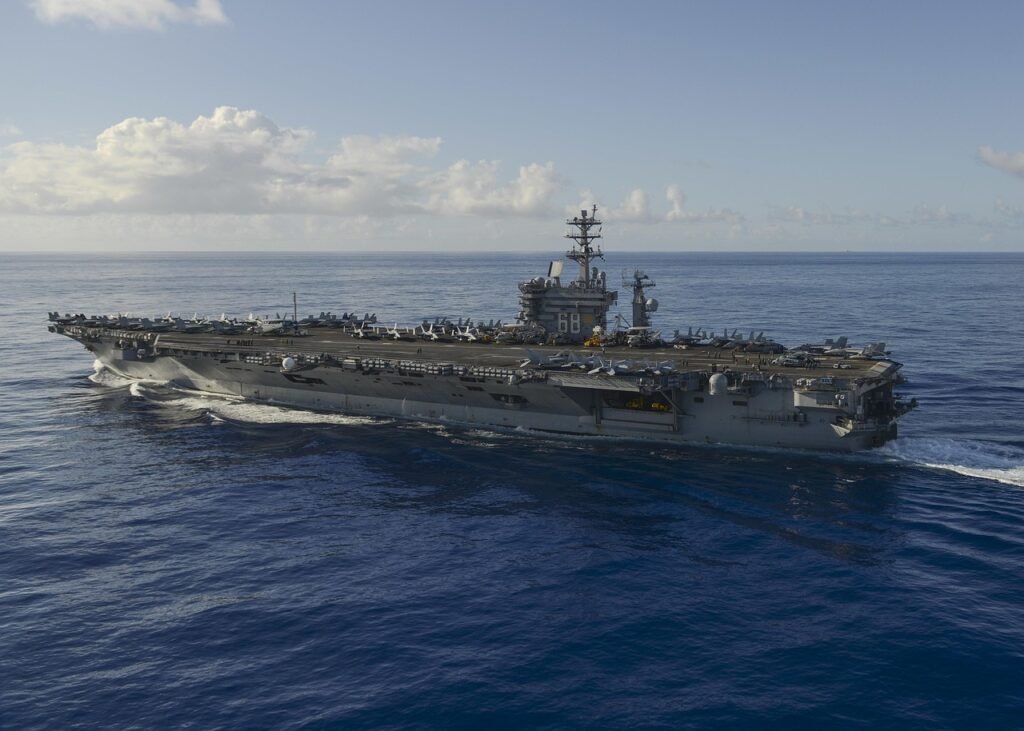
Wallstreet Soulja – “War Machine Series”
Source: YouTube – Inside US Biggest Nuclear Aircraft Carrier | Gerald R Ford
Modern markets are influenced by more than earnings reports and interest rates. Military power, trade routes, and geopolitical tension can move global capital. One of the most powerful symbols of this relationship is the aircraft carrier.
Key Facts
- The USS Gerald R. Ford (CVN‑78) is the lead ship of the Ford-class nuclear aircraft carriers.
- Construction cost: roughly $13+ billion, making it the most expensive warship ever built.
- It is designed to replace the Nimitz-class aircraft carrier.
- Major technological upgrades include:
- Electromagnetic Aircraft Launch System (EMALS) instead of steam catapults
- Advanced Arresting Gear (AAG) for landing aircraft
- Higher sortie generation rate (more aircraft launches per day)
- Reduced crew size through automation
Operational role:
- Serves as a mobile airbase capable of projecting U.S. power globally.
- Typically carries 70+ aircraft including:
- F/A‑18E/F Super Hornet
- F‑35C Lightning II
- E‑2D Advanced Hawkeye
Several major defense companies play critical roles:
Huntington Ingalls Industries (HII)
The sole builder of U.S. nuclear aircraft carriers at Newport News Shipbuilding. Carrier construction contracts are worth tens of billions of dollars and sustain thousands of skilled engineering jobs.
Northrop Grumman (NOC)
Developer of the EMALS launch system and other advanced electronic systems integrated into Ford-class carriers.
Lockheed Martin (LMT)
Manufacturer of the F-35C Lightning II, the next-generation stealth aircraft designed for carrier operations.
Financial Warfare Insight
In the modern world, military power and financial markets are deeply correlated.
A $13 billion aircraft carrier entering a region is not only a military signal—it is a market signal.
Oil traders watch tanker routes.
Defense investors monitor procurement cycles.
Shipping companies adjust freight pricing based on geopolitical risk.
Understanding these relationships is essential for anyone navigating the intersection of geopolitics, capital markets, and global trade.
Market Signals to Watch
• Oil prices when tensions rise near major shipping lanes
• Defense stocks such as companies involved in carrier systems
• Shipping insurance and freight rates during conflicts
Understanding the relationship between military power and global markets is essential for modern investors. Aircraft carriers are not just tools of war — they are signals of economic influence in the global financial system.